
 Dragos Iordache
 Ionut Petre
The concept of multi-level governance represents a new paradigm for understanding how authority and competences are distributed and shared between the European institutions, the Member States and sub-national authorities.
Multi-level governance (MLG) is not limited to explaining the vertical subordination relations between these levels, but also emphasizes the importance of horizontal cooperation between actors operating at similar levels, such as collaboration between regions of Member States or between local authorities. Furthermore, this concept integrates diagonal interactions, which cross various sectors and policy areas, reflecting the complexity of contemporary governance in the European Union, where traditional sectoral approaches are being replaced by the need for intersectoral and inter-institutional coordination.
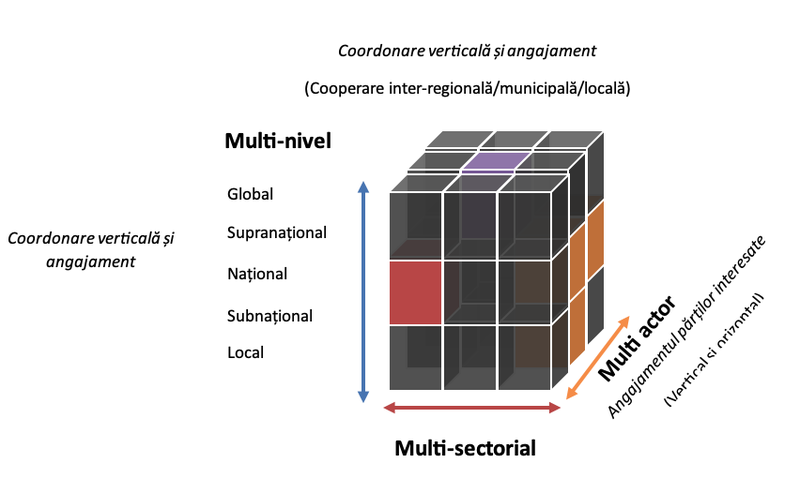
Thus, multi-level governance becomes a comprehensive analytical framework, covering three distinct dimensions (as in the figure) that regulate authority and cooperation relations within the European Union: the vertical dimension (multi-level), the horizontal dimension (multi-sectoral), the diagonal dimension (multi-actor).
Vertical dimension (multi-level)
This dimension refers to the distribution of authority and responsibilities between supranational, national, regional and local levels of government. Decisions are no longer taken exclusively by national governments, but involve a delegation of powers between the different levels, ensuring a more open and balanced governance. MLG allows for a better adaptation of policies to the local context, while maintaining coherence with supranational norms and regulations. In the European Union (EU), multi-level governance ensures the effective implementation of policies and respect for regional and local diversity and specificities. The main features of vertical governance at the European Union level at supranational and national governance structures, the role of regions and local authorities, the principle of subsidiarity.
The EU operates on the basis of a system of governance that includes supranational institutions (European Commission, European Parliament, Council of the EU) and national authorities (governments of the member states). This structure allows for the alignment of European policies and legislation with national needs and priorities. Many EU policies are implemented directly by regional and local authorities, while others require collaboration between different levels of government. The principle of subsidiarity, enshrined in the Maastricht Treaty and other fundamental EU documents, stipulates that decisions should be taken at the level closest to the citizens, whenever possible. Thus, competences are distributed between the EU and the member states depending on the efficiency and effectiveness of intervention at different levels. Multilevel coordination mechanisms help manage interactions between different levels of government, including intergovernmental committees, working groups and collaboration platforms.
Horizontal (multi-sectoral) dimension
The horizontal (multi-sectoral) dimension focuses on cooperation between actors operating at the same level of government, such as interactions between regional authorities in different countries or between local organisations within the same region. The European Union encourages cooperation between regions and localities in the Member States through various mechanisms, such as the Committee of the Regions or cross-border cooperation initiatives (Interreg). This dimension allows the exchange of knowledge and good practices between regional and local authorities, promoting convergence between different areas of the Union. Partnerships between Member States contribute to the development of more coherent and effective policies at European level, in areas such as transport, environmental protection or economic development.
The multi-sectoral dimension emphasises collaboration and coordination between different sectors, in order to address complex problems that cannot be effectively addressed by a single sector or centralised authority. This dimension is characterised by providing an integrated policy framework that addresses cross-cutting issues across several sectors such as energy, transport, agriculture and industry.
Diagonal (multi-actor) dimension
This dimension intersects both the vertical and horizontal dimensions where sectoral policies are often interconnected and require collaboration between multiple levels of government and actors from diverse fields. For example, climate change or digitalisation policies require not only collaboration between European institutions and Member States, but also the involvement of the private sector, non-governmental organisations and civil society. The European Union, being a supranational entity that includes states with diverse political, economic and cultural systems, has developed mechanisms and structures that allow the participation of multiple actors in the decision-making and governance process.


