 Florin Pop
 Ionut Petre
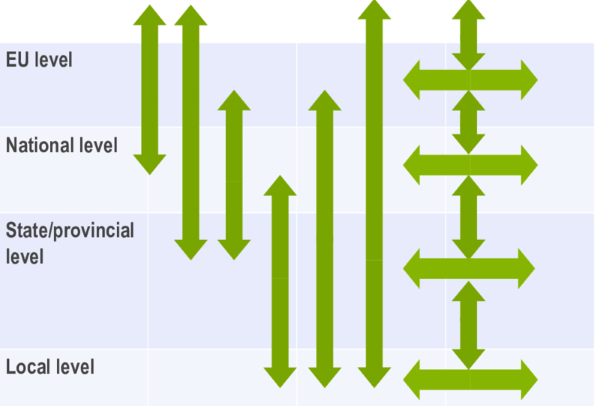
In recent decades, European integration and the decentralization of political authority have significantly reshaped the way decisions are made and policies are implemented in the European Union. This model transcends the traditional framework of the nation-state, consisting of a complex network of regional, national and supranational actors, working together to address diverse political, economic and social issues.
At the heart of the European model of multi-level governance is the distribution of authority between different layers of government. These layers range from local and regional levels, to national governments and, finally, to the supranational level represented by the European Union (EU). Each of these levels exercises a certain degree of autonomy and responsibility in shaping and implementing policies. The basic principles of multi-level governance in the European Union are: the principle of shared/overlapping decisions, the principle of subsidiarity, overlapping competences, flexibility and adaptability, broad participation and European integration.
The European model of multi-level governance is characterised by the principle of sharing decisions between these different levels of government. Political decisions are therefore often the result of negotiations and collaboration between local, national and supranational actors. An example of this is the co-decision procedure, whereby both the European Parliament and the Council of the European Union must agree on legislation in certain areas. This sharing of decisions increases democratic legitimacy, ensuring the participation of more actors in the governance process and ensuring that no one entity has excessive power over others.
Another aspect concerns the principle of subsidiarity, which states that decisions should be taken as close as possible to the citizen. According to this principle, the European Union should intervene only when objectives cannot be achieved effectively by the Member States or regional authorities. This avoids excessive concentration of power in Brussels and ensures governance adapted to local needs and preferences. Subsidiarity promotes decentralised governance, giving local and regional authorities powers in areas such as education, health, transport and environmental management, and is aligned with the EU’s commitment to preserving the diversity and autonomy of Member States while promoting common European objectives.
Another important feature of the multi-level governance model is the sharing of powers and jurisdictions between different levels of government, which requires extensive coordination and collaboration. For example, the European Union sets general environmental regulations, but their implementation is often the responsibility of national or regional authorities. Another example is cohesion policy, through which regional development is influenced by both national policies and EU-funded programmes, creating a complex network of shared responsibilities.
Adapting to the various specific challenges that arise at regional or Member State level requires a flexible governance model. Unlike rigid hierarchical systems, the MLG model facilitates dynamic interactions, allowing different decision-making centres at different levels to take the lead depending on the issue at hand. Flexibility is particularly evident in areas such as crisis management or climate change. For example, during the COVID-19 pandemic, EU institutions, national governments and regional bodies each played a specific role in addressing the crisis, demonstrating their capacity to respond to unforeseen events. In addressing climate challenges, the EU sets climate targets and regulations, while Member States and regions have the flexibility to adapt their approaches to their specific circumstances.
One of the most dynamic aspects of governance in Europe is the active participation of non-governmental actors in policy-making. In addition to government authorities, the MLG model integrates: civil society organizations that advocate for issues such as human rights, environmental protection and social justice, interest groups and lobbies or the private sector and here we are mainly talking about public-private partnerships in areas such as infrastructure development, innovation and digitalization. All these actors are an integral part of the success of the MLG model, as they provide expertise, representation and support for various community policy initiatives.
By integrating new members, the European Union has significantly influenced the governance structures of its member states, promoting decentralization and regionalization in countries with centralized traditions. This integration generates both opportunities and challenges, strengthening unity and collaboration within the EU, but also raising issues related to the erosion of national sovereignty and conflicts between national and European legislation.


